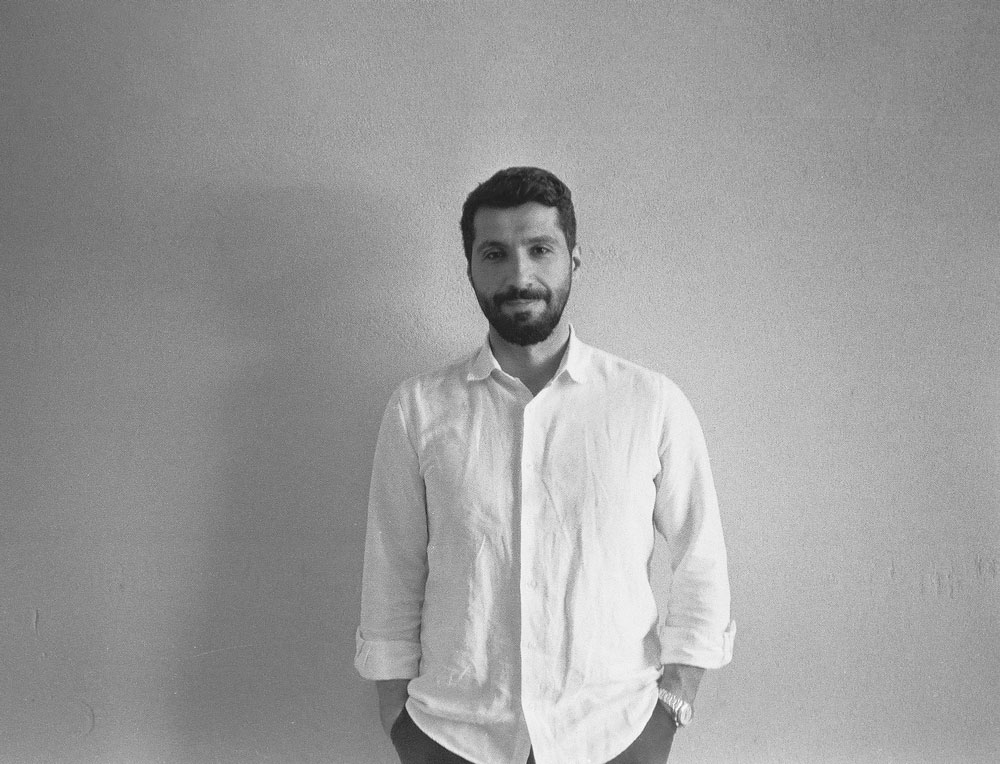


In this edition of the Journal, we enter the place where the collection begins before it gains touch: the Design Department. In light of SYNAPTIC (SS27), this edition marks the debut of Textile Designer Joseane Oliveira at Trimalhas and extends an invitation to reconnect in a saturated world, where knitted fabric is no longer just a surface but asserts itself as a living interface. We spoke with the Designer about vision, process and detail. Between trend and timelessness, innovation and know-how, the interview reveals how structures are designed that welcome, breathe and elevate everyday life with awareness.
THE INTERVIEW
When you joined Trimalhas, what was the first ‘sign’ that made you realise the DNA of the company?
As a designer, I was already familiar with Trimalhas and other companies in the sector, which allowed me to form an understanding of the identity and ‘personality’ of each one. I saw Trimalhas as a cutting-edge company, not only in product development, but also in the way it positions itself and communicates, and it naturally came to mind as a reference when I thought of more daring structures. When I joined the team, I confirmed this perception. One sign of this DNA is the size of the collections: they are not excessive. The focus is not on developing for the sake of developing, but on creating products with direction, identity, quality and awareness. Each knit has intention and purpose, and the goal is not to be ‘more of the same’, but to be truly different, supported by high standards and a well-defined quality benchmark.
For you, what separates a “good” knit from a truly “premium” knit, and from a “luxury” knit?
For me, good knitted fabric is well-made basics: a jersey with good recovery, an American fleece with a beautiful loop, a well-finished smooth interlock. These are items that we could develop almost ‘with our eyes closed’ and that we know will be in demand because they are, in fact, good. I see premium knitted fabric as a distinctive product, whether in terms of fibre, yarn, structure or finish. It requires greater technical work. Therefore, premium is not unattainable: it is different, it is excellent, but it is tangible. Often, premium used to be luxury. Luxury is the ultimate goal. We are talking here about knits with high added value, which start from the development of something innovative and different: complex structures, differentiated yarns and innovative finishes. Being a benchmark in the development of knits for the luxury market means, first and foremost, doing all the other steps well. The foundation is the key to everything.
Can you walk us through your process: from the first insight to the final approved sample?
As a creative person, my first insight is to observe what the world has been experiencing. Society works like a pendulum: what was once will be again. If we can read these movements and apply them to product development and business, we will be one step ahead. In concrete terms: observing concepts and behaviours and questioning what people will wear or buy. This is a daily exercise. The second insight almost always comes the other way around: I think first about the final product, what pieces or models can be developed and for which brands and segments, then about the fabrics that can meet these needs, across the market and, ideally, timelessly. Will it be a jersey or an interlock? What is the weight, feel and appearance? With this basis, we see if the knit is reproducible, and as a team we select the yarn, the structure, the most suitable and profitable loom, and the ideal finish. It is a collaborative effort, in which each person has their own expertise, and it is this collaboration that transforms the idea into a product. Everyone is a living part of this journey. A knitted fabric is born from an idea, but it only comes to fruition through the work of everyone, from the yarn to the planning, from the knitting to the finishing, from the review to the final tests, from the preparation of the hangers to the warehouses, to the financial and commercial team. It is a true journey of transformation, in which the final result often differs from what we see when it comes off the loom.
How do you transform trends into Trimalhas language: what remains beyond the season?
I believe that collections should increasingly be designed beyond seasonality. Winter blends into summer and the seasons are no longer so clearly defined. Transposing trends in this context of market change leads us, almost naturally, down the path of timelessness. There are many trends, and we need to observe macro and micro trends, interpret them and bring them into our reality, considering our human and manufacturing capabilities, our customers and what we want to project. That is why each trend ends up gaining the Trimalhas language, as long as we remain consistent with our values: creating irreverent, high-quality knits that are made to last. In the end, each trend is always interpreted according to our DNA.
What did you observe in the world (and in consumers) that led you to design the SYNAPTIC collection as a reconnection, and not just as aesthetics?
I feel that the world is increasingly saturated with information and trends. Of course, I make this observation with the awareness that the world is vast and that there are realities where this excess has not yet arrived. But, in general, globalisation has made us hyperconnected, in a fast-paced rhythm of overlapping information. Synaptic emerges as an invitation to reconnect: to think before reacting or buying, to reflect before responding, to live each moment consciously and allow experiences to flow naturally. After Turmoil, which portrayed the commotion and turmoil that drive creativity, comes calm, the desire to reconnect with our lives, with the moments of the day, with the environment and with the way we consume. Dressing is a natural part of this daily journey, and it is essential that we feel comfortable, both physically and mentally. This is where knits take centre stage: not only as an aesthetic element, but as something that reconnects us with our personal taste, makes us more aware of our choices and makes our daily lives more enjoyable.
The collection suggests three territories: INNERFACE / REWILDING / SYMBIOTIC. How do you translate each of these axes into concrete decisions?
Each concept has its own main idea, but they are all connected to a central theme. At Innerface, we explore what is not immediately visible. We play with right and wrong sides, threads that cannot be seen, finishes that can only be felt and that make the knit special: we have double-sided vanised knits such as California 201, or mercerised Interlock Pique, such as Aurea 100; we have vertical stripes in colour and structure, as in Duna 100. Rewilding proposes exploring new possibilities. The starting point is: what already exists and can be improved? We work with natural, regenerated and recycled fibres, valuing irregularities such as slub yarns, mélanges, bouclés and open ends. Knits with relief, ribbing, stripes, herringbone and distinctive loops. Examples: Pointelle 101, a 100% organic cotton jacquard rib with a ribbed structure and aerated stitches, or Origen 100, in organic cotton and recycled polyester with horizontal stripes in bouclé yarn. The Symbiotic concept is at the heart of the collection. It connects nature and technology, body and knit, yarn and structure, finish and feel. The two previous concepts inspire, but it is Symbiotic that gives cohesion and name to the collection. Knits such as Sleek 100, cotton/silk pique with a soft touch and a drape that hugs the body, or Lunor 201, striped linen/cotton jersey, combining comfort, premium aesthetics and versatility, translate the DNA of this collection into practice.
There is talk of journeys from rest to movement, from the intimate to the collective, with a focus on versatility. What design strategies do you use to ensure this adaptability without losing sophistication?
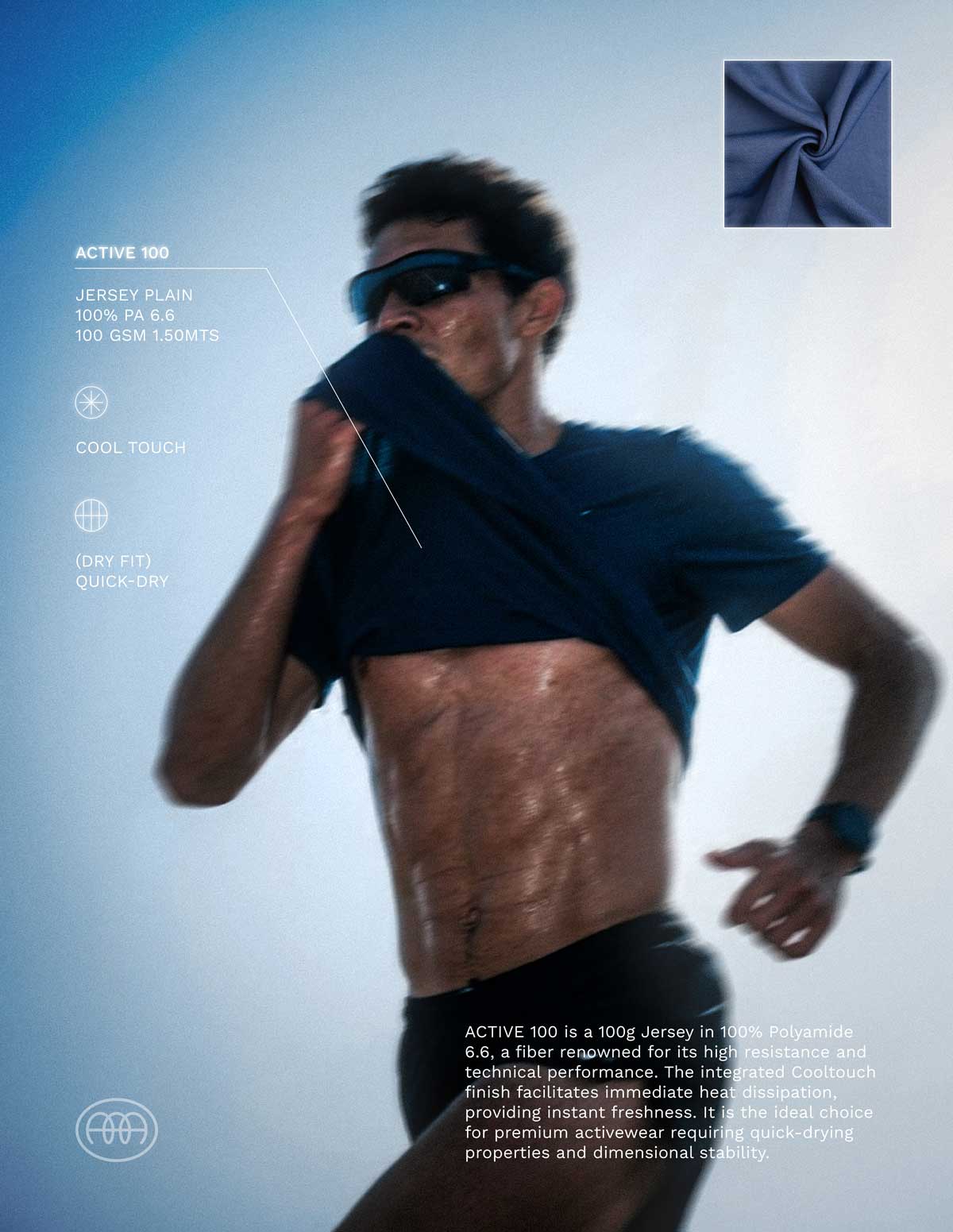
We use structures and finishes that, above all, provide comfort. Knits that fit without weighing down the body, such as Amber 100, 100% recycled polyamide pique with an antibacterial finish, whose drape and feel make us wonder: is it the yarn, the structure or the finish? Or Active 100, a cool-touch jersey, Padel 100, a Lyocell/cotton pique, which even without a functional finish offers comfort and versatility, ranging from casual to sportswear, reflecting the journey from rest to movement. The goal is not extreme performance; we reserve that for very specific knits, planned for 2026. We want to create functional, sustainable knits that are adaptable to different segments and the lives of end consumers. A polo shirt that can be worn for playing tennis can also be worn to work or a special event, combining function, comfort and sophistication.
The text mentions “neuroactive textures” and a “bioemotional aesthetic”. What do these concepts mean to you in practice? Is there a texture/structure in this collection that best represents this idea?
Neuroactive and bioemotional textures are related to what stirs our emotions and neural activities, evoking comfort versus discomfort, beauty versus aversion, pleasantness versus irritability. It is like when we touch a soft or fluffy fabric and want to repeat the gesture, or when we feel a rough surface and feel uncomfortable. Our tactile sensitivity is a major activator of well-being or discomfort. Each texture activates a function. Therefore, it is essential to define what sensations I want to convey with the knitted fabric, through the choice of yarns, structures and finishes. In this collection, for example, I always think of Origen 100: its fluffy texture and stripes evoke the feeling of a comfortable day at the beach.
The concept points to fabrics that ‘breathe, mould themselves and embrace’. What technical criteria validate this in development? And how do you transform technical tests into creative choices?
In some cases, we achieve this through the structure: a more open jersey to ensure better ventilation. We add elastane to improve recovery; as a rule, knits already have a certain natural elasticity, but this is not always sufficient, and elastane plays an important role here. Moisture management is another important feature, achieved through the appropriate choice of yarns. Polyamide 6.6 offers low absorption and quick drying; recycled polyester combines quick drying, good durability and resistance; Lyocell provides a soft touch, good breathability and natural absorption; cotton combines comfort, breathability and mechanical resistance; linen ensures ventilation and tensile strength; and wool, especially merino, offers thermal regulation. Knowing these properties allows us to recognise yarns with intelligent fibre combinations to increase resistance, functionality and aesthetic effects. Although sustainability favours single fibres, well-thought–out blends can be functional for some products and can help extend the product life cycle, which is also a sustainable strategy.
The collection speaks of technological finishes and technology as an ally. What ‘innovation’ excites you most today in knitted fabric design, and how do you ensure that it serves well-being and not just the ‘wow’ effect?
I think the main point for this ‘wow’ factor is the ability to be different, but at the same time reproducible. Innovation requires boldness, research, time and energy. Using something new after everyone else has already tried it keeps us attentive to the market, but it doesn’t make us innovative. Recognising new yarn technologies is part of this journey. In this collection, for example, we will use Umorfil, which applies supramolecular technology to integrate collagen peptide amino acids, obtained from food waste (recycled fish scales) applied to base materials such as polyester, viscose and nylon. We will also have innovative finishes, such as Relax CBD, with a calming and relaxing effect, whose use had already been considered before my arrival. These solutions are interesting: the first for its insightful technology and sustainable bias; the second for bringing a bioactive component to textiles, through impregnation by microcapsules, as a wellness proposal. These are innovations from suppliers that we have integrated into the collection. Beyond that, the goal is to innovate from the ground up. Knowing that Trimalhas offers this opportunity is what motivates me to research. So the goal with each collection is to seek innovation, with awareness and consistency.
Sustainable/regenerative raw materials and circular processes appear as the basis. What is the role of design in sustainability (even before production)? What design decisions reduce impact and increase longevity and durability?
Thinking sustainably is becoming increasingly natural, although complete sustainability is still a challenge. As a designer, I need to create fabrics that make conscious use of resources, have a long life cycle and are disposed of responsibly, considering the fibre, yarn, structure, finish and final destination: how long will it last? Will it have a second or third life? Is it recyclable or biodegradable? What is its environmental impact? Reflecting on all this during the creative process is challenging, but we cannot let complexity block creation. Being sustainable requires work: traceability, quality, price, and acceptable minimums. And consistency allows us to build a repertoire and knowledge about raw materials, making the process simpler over time. This is where I find Trimalhas’ values: structured knits allow us to develop conscious products, attentive to detail and capable of ensuring real sustainability.
The inspiration palette and keywords include confident, slow, restorative, multisensory, connection, as well as tactile, human, nostalgic, natural. If you had to choose one knit from this collection to symbolise SYNAPTIC, which one would it be? And what feeling do you want the wearer to take away with them when they wear it?
Choosing a favourite knit is always difficult, especially when I think of them with affection and enthusiasm. At the same time, self-criticism always arises: what could I have done better? And this is essential so that we don’t become complacent, because we can and must always improve. Improvement is a commitment to ourselves and to the process that we must undertake on a daily basis. But to conclude, my favourite knit is Sleek 100. It is a knit with a simple structure, but one that conveys the feeling of something really good, which inspires comfort, good choices, a product for life. That is exactly what I would like people to feel.